
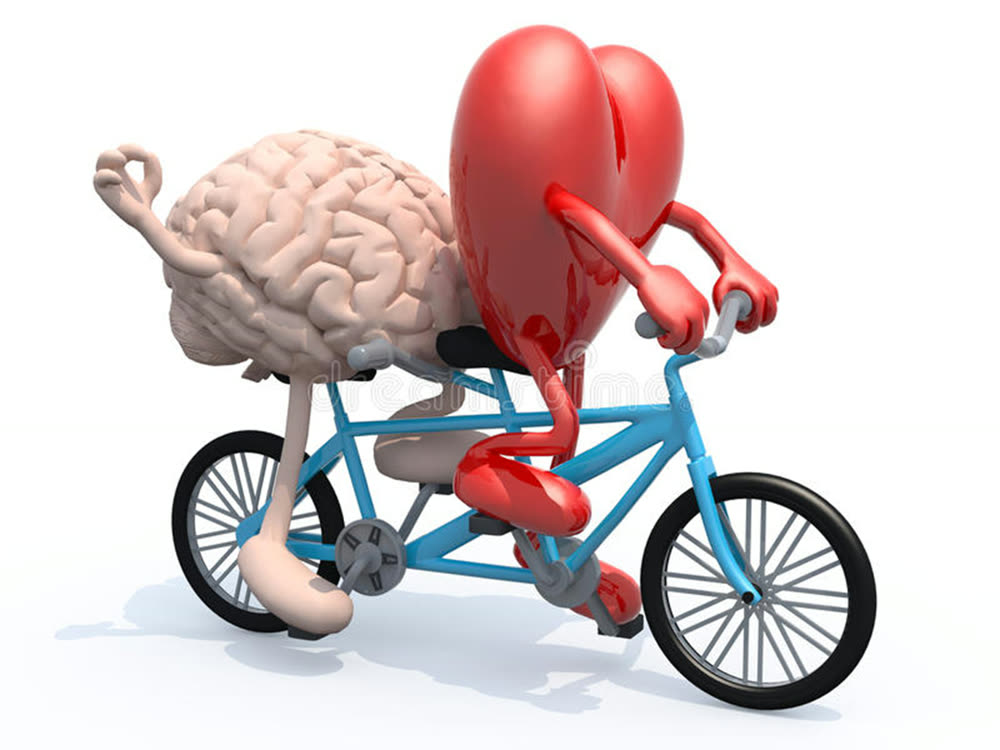
When I first came across the finding by Tali Sharot, a cognitive neuroscientist, that humans stick to `their' facts even in face of clear evidence that they were made up, I started wondering what this would mean for personal development, teaching, and parenting. With the help of brain imaging, the study found that whether or not you stick to `your' facts depended on a small structure deep inside the brain, about the size of a cherry tomato. This structure is called the amygdala and is essential for emotional arousal. It was found in an experiment that an activated amygdala - a measure of emotional involvement - made it less likely that the subjects later corrected what they took as facts. This cements the importance of emotions for learning and at the same time raises concern about their limitations. The big question is how to use emotions to our advantage as getting that right can have huge rewards. Before we dig any deeper let's first define the scope of this article. This article is not about Emotional Intelligence, a buzzword popularized by Dan Goleman in the 90s. EI is the ability to understand and manage your own emotions, as well as recognize and influence the emotions of those around you. The EI movement, which preferred to use the term EQ (emotional quotient) instead, gained much traction primarily because it positioned EQ as a competition to IQ. Though there are some philosophical objections I have to EQ/EI, those too are beyond the scope of this article. Similarly, this article is also not about advocating free reign for emotions. Instead, the intellect should harness emotions to ensure the correctness of direction and sufficiency of energy. Therefore, this discussion is about how intellect alone is not enough to shape behavior, particularly in the longer term. A comprehensive pedagogical approach should take emotions into account at least as much as intellect.
Islam Recognizes the Importance of Emotions
Is the above-discussed finding really a discovery? Allah (swt), the Creator, and Rasoolallah (saw), the best of humans, have resorted to emotions abundantly. There are countless Ayat in the Qur'an that talk about the heart. One such ayah is in Surah Ale-Imran [3:8], where Allah (swt) taught us the Dua:
"Our Lord, let not our hearts deviate after You have guided us and grant us from Yourself mercy. Indeed, You are the Bestower."
More practically, the Prophet (saw) in his dealings would address the emotions wherever necessary. So for instance after Ghazwa-e-Hunain, where Muslims captured a lot of ghanaim (war booty) and the Prophet (saw) distributed most of it amongst those Quraish and other tribes who had just accepted Islam to facilitate and encourage them (catering to their feelings). This left some Ansar disgruntled at not receiving anything or too little despite having fought bravely in adverse conditions. Their complaint made rounds and reached the Prophet (saw) through Sa`d bin `Ubadah who said: "O Messenger of Allâh, this group of the Ansar are furious at you about the distribution of the booty that you had won. You have allotted shares to your own kinsmen and forwarded lots of gifts to the Arab tribes. But this group has obtained nothing." The Prophet (saw) gathered them and here is an excerpt of what he (saw) said: "You Ansar, do you feel anxious for the things of this world, wherewith I have sought to incline these people unto the Faith in which you are already established? Are you not satisfied, O group of Helpers that the people go with sheep and camels while you go along with the Messenger of Allâh to your dwellings?" The audience wept until tears rolled down their beards as they said: "Yes, we are satisfied, O Prophet of Allâh with our lot and share. [Ibn Hisham and Bukhari]
Now imagine your authority being challenged, be it in the capacity of a parent or in a corporate setting, what do you resort to as a response? "I'm the parent, I know better", "Its company policy, according to such and such rule..." etc. And in this case, the one whose acts were challenged was the Supreme leader of Muslims, acting upon Allah's (swt) orders, and instead of resorting to such reminders, he addresses their emotions. What result did that achieve? Complete submission, remorse at their behavior, and resolve to never repeat such complaints. This is the power of emotions.
To further understand this concept, and also to demarcate the limits of each, intellect and emotions, consider the horse and jockey metaphor often used by scholars. In a horse race, the jockey represents intellect, while the horse represents emotions. Neither could win the race alone, as the jockey won't be a match for other horses and the horse alone might run in the opposite direction or be distracted on the way and might never make it to the finish point. It is only when the intellect is on top of emotions that we can benefit from the synergy.
The limits of intellect also get quite clear when we observe our own behavior. Isn't it true that despite mostly `knowing' what is harmful or prohibited, we still have difficulty restraining ourselves from it? Riba (interest) for example is something many Muslims struggle to refrain from despite its clear prohibition. On the other hand, if we dislike something at the emotional level, no amount of benefit might convince us in favor of it. Pork is a case in point. Muslims' disgust with pork stems from the intellect, the clear prohibition of consuming it. However, it runs much deeper, and it is unimaginable for most to even touch the animal or its meat. Finding a Muslim who would consume pork is highly unlikely even in the Western world. Hence, emotional experiences are a key tool for parents and teachers alike. Positive ones will lead to reinforcing certain behaviors and negative ones will help discourage others.
The stories of the very first Muslims, be it Khadija (ra), Abu Bakr (ra), Ali (ra) or Zaid (ra), all teach us the same lesson, which is that their love and emotions for the Prophet (saw) was stronger than any intellectual discussion could have been. For them, it was a foregone conclusion that the person Muhammad (saw) can never lie or deceive and hence we don't see reports of lengthy intellectual argumentations between them and the Prophet (saw) when he proclaimed prophethood. Of course, their love for the Prophet (saw) was built on solid intellectual foundations, meaning they established over the years how truthful, honest, sincere, and kind-hearted he was. But their love definitely outgrew those intellectual underpinnings and transformed into an unshakable emotional bond. To show how intellect and emotions are interconnected and influence each other consider the story reported by Abdullah ibn Hisham and recorded in Sahih Al-Bukhari: He reported that we were with the Messenger of Allah, peace and blessings be upon him, and he was holding the hand of Umar ibn al-Khattab. Umar said to him, "O Messenger of Allah, you are more beloved to me than everything but myself." The Prophet said, "No, by the one in whose hand is my soul, until I am more beloved to you than yourself." Umar said, "Indeed, I swear by Allah that you are more beloved to me now than myself." The Prophet said, "Now you are right, O Umar."
Allama Iqbal's Aql versus Ishq
Allama Iqbal, like his master Rumi, is of those few scholars who not only understood the power of emotions and the tussle between intellect and emotions but also taught it to the whole world through his poetry. He doesn't deny the importance of employing intellect to find the truth but at the same time also cautions of the various ploys intellect can play to find excuses when the emotions are not in the right place. In his words:
عقل عیار ہے، سو بھیس بنا لیتی ہے
عشق بےچارہ نہ ملا ہے نہ زاہد نہ حکیم
Similarly, he emphasizes the power of emotions, which are like a driving force in difficult situations, where intellect might see it rational to back out, but emotions will take us through. His reference to the story of Ibrahim (as) and Nimrood's attempt to burn him alive is beautifully summed up in the following couplet:
بے خطر کود پڑا آتشِ نمرود میں عشق
عقل ہے محوِ تماشائے لبِ بام ابھی
Personality
From the discussion above it should be clear that the human personality is made up of primarily two components, Aqliyya (intellect) and Nafsiyya (inclinations). This was understood by the classical scholars very well and therefore traditionally there was always a balanced emphasis on developing both, to develop wholesome personalities. However, the rise of scientific thinking after the Renaissance in the West and the rise of `factory model schools' in the early 20th century, has disproportionally shifted the focus on intellect, at times completely ignoring the importance of emotions. The recent finding by Tali Sharot and her team seems to contest this view and reminds us of the central role emotions play even while seeking the truth. Be it the eternally cursed Iblees or Abu Jahl, their problem was definitely not a weakness of intellect, but rather confounded emotional issues, be it extreme arrogance or extreme enmity, which fogged their judgment. Unfortunately, modern education and schooling have been late to adjust and consequently, students' emotional well-being is oft-ignored. As an example, instructions like `sit straight', `don't talk', `sit down', `no laughing', `no cheating' are common phrases heard from teachers as early as Montessori and pre-school. The use of corporal punishments is also not uncommon in schools and madaris (seminaries) for petty reasons. Nail checks, lice checks, penalties on unkempt hair, and public shaming for coming late are far too common. Parents too are guilty of similar behavior with their children. The age when developing their nafsiyya through love and repeated actions would've been easiest is lost in teaching them concepts and enforcing discipline, devoid of emotions. Interestingly, pupils in our schools and madaris are the most organized, when it comes to metrics like punctuality, hygiene, and discipline but our societies are the most disorganized on the same metrics. Why is it so? Well, one explanation is that instead of instilling love and affection for such behaviors, we instill hatred because of excessive strictness and fear. Therefore, as soon as the checks disappear, people revert to their default or even become rebellious.
To understand the difference between aqliyya and nafsiyya let's use driving as a metaphor. While learning the theoretical part of how to operate a car (steering wheel, pedals, gears, etc.) is pretty simple and won't take more than a day, the practical part - that of translating theory into actions - is quite challenging for many and requires days if not months of practice. Why is it so? Well, initially when someone drives for the first few times, they have to send a query for each and every decision to their brain and the brain returns an answer, requiring a lot of time. So when you have to stop the car, you ask your brain which pedal to press, how much to press, and so on. As time passes and this process is repeated many many times, it becomes like second nature, and the brain is almost bypassed and such decisions become the default. In exactly the same fashion, humans can develop good habits (or even bad ones) which will require no amount of intervention from the brain, thereby reducing the chances of an erroneous decision (in case of good habits). So the mere thought of pork or even alcohol should trigger disgust and repulsion. Similarly, prayer and fasting should elicit positive emotions. If that is the case for all the prohibitions and commandments respectively, you have succeeded in developing a perfect nafsiyya. Imagine how easy it would then be to follow Allah's Deen!
Developing a Good Nafsiyya
Developing a good nafsiyya in yourself requires God-consciousness (taqwa) and constantly engaging in the process of purification of the self (tazkiya-e-nafs). Its easier said than done, but remaining attached to the Quran (both recitation and understanding), good company, and clear personal goals do help a lot. Instilling a good nafsiyya in children is actually much easier for both children (as they don't have to unlearn anything) and parents. The key is to associate positive feelings and emotions with the behaviors and actions we want to encourage and to associate negative ones with those we want to discourage. This is done with stories from the Quran, the Seerah, and the life of the Sahaba (ra). However, sometimes the wrong choice of schools (and resultingly friends) makes parents' job more challenging. If the social environment of the school is much different from that at home, it is going to create unnecessary tensions in the child's mind and heart. Therefore, we must save them from this agony as much as possible. Unfortunately, it is observed that in our society most parents dream to send their children to schools that they can barely afford, and which are on the modern/liberal side. Their intentions are usually pure, as they just want their children to be confident and fluent in English. However, the children often end up being `bold' instead of confident, challenging anything they think is outdated, be it Islam!
May Allah (swt) help us in developing a good nafsiyya in ourselves and those we are responsible for.
If any of this is live in your own home right now, the first conversation is free.
Book a free consultation